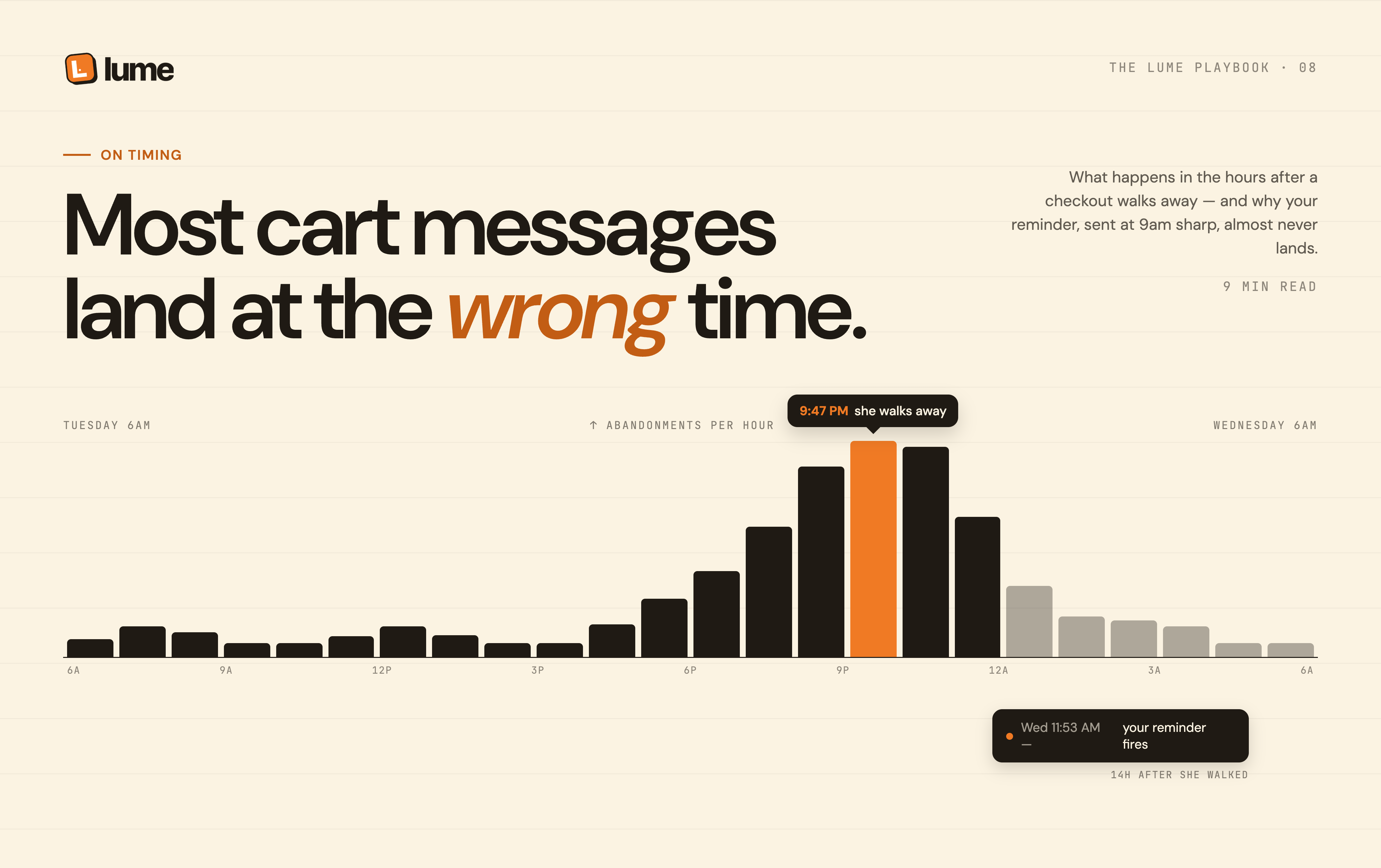
A customer walks away from your Wix Stores checkout at 9:47pm on a Tuesday. Something pulled them away. They had a question about sizing, or their phone rang, or they decided to check the price on Amazon real quick before paying.
When do you message them?
The standard answer, the one almost every Wix Stores merchant runs and almost every guide recommends, is one hour, then 24 hours, then 48 hours. I think this cadence is wrong, and I think it's been copy-pasted between ecommerce blog posts so many times that nobody actually questions where it came from. Wix's own native abandoned cart recovery defaults to roughly this rhythm. So does almost every WhatsApp tool that plugs into Wix.
The honest version is that nobody really knows the optimal cadence for any individual store. There isn't a published study I trust on this. But the 1/24/48 default doesn't match what I see when I actually look at how people abandon carts on Wix Stores, and the more I've thought about it, the more I think most merchants are leaving recovery revenue on the table because they're running the cadence everyone else is running.
Here's how I'd think about it instead.
The problem with the default cadence
The default assumes the customer abandoned because of a temporary distraction, and that a reminder will pull them back. Then it assumes 24 hours later they'll need a new reason to return, and 48 hours after that they'll need a discount.
There's nothing crazy about this logic. The issue is that it treats every abandoner as the same person.
When you look at why people actually leave a Wix Stores checkout, they fall into a few different shapes:
There's the distracted buyer who genuinely meant to finish. Their kid yelled, their UberEats arrived, they got a Slack notification. These customers want to buy. They just stopped.
There's the comparison shopper. They left to see if the same thing is cheaper elsewhere, or to read reviews, or to check shipping speed. Their decision happens that day, often within a few hours.
Then there's the price hesitator. They wanted it. They couldn't quite justify the total. They aren't coming back without a reason usually money off, or free shipping, or something that changes the math.
And then there's the window shopper, who was never going to buy and added to cart because that's just what people do online now.
The default cadence sends the same message to all four. The first reminder reaches the distracted buyer in time (good) and annoys the window shopper (whatever). The second message at 24 hours misses the comparison shopper they made their decision already. The third message reaches the price hesitator finally, often with a discount, which means anyone in the first two groups who would have paid full price now has a coupon they didn't need.
The flow still recovers some revenue. It's just not recovering as much as it could.
A timing model that fits the actual behavior
Here's what I'd run on a Wix Store instead.
Twenty minutes for the first message, not an hour. This is the change I'd push hardest. The distracted buyer is the most valuable customer you're trying to reach, and an hour is too long. By then they're in bed, or eating, or have closed the tab. Twenty minutes catches them while the credit card is still mentally out.
The message should be deeply unfussy. No urgency, no discount, no "we noticed you left something behind" copy. Just: "Hey, your cart's still here when you want it," plus a link that works.
Wix's native recovery emails can't really hit this window; by the time the email is composed and sent and the customer happens to open their inbox, you're already 30+ minutes deep. This is why WhatsApp matters specifically for this first message. It fires in seconds, and the customer reads it in seconds.
Six to eight hours for the second message, not 24. This is where I think most Wix Stores leak the most revenue. The comparison shopper isn't waiting until tomorrow. They're deciding tonight. By the time your 24-hour reminder fires, they've already paid someone else.
A 6-to-8-hour message catches them mid-comparison. And the message should do something useful: answer the question they're probably Googling. Something like: "Just so you know, free returns within 30 days, ships in 2 business days." "Cart's still here." That's a more useful message than "still thinking about it," which prompts nothing.
36 to 48 hours for the third message, with the offer up front. By now you're talking mostly to price hesitators. The first two groups have either bought or moved on. This is the right moment for a discount or free shipping, because the population that's still around after 48 hours skews price-sensitive.
Make the offer the headline of the message. Don't bury it under another "still thinking?" line.
Don't send a fourth. A lot of Wix Stores merchants do sometimes because their tool defaults to it, sometimes because they've been told more messages mean more recovery. The math after 48 hours gets bad fast. The people you'd be messaging are mostly window shoppers, and the opt-outs you generate cost more than the trickle of recovered orders. There's also a Meta sender-quality cost, too many ignored or blocked messages, and your WhatsApp number gets throttled, which hurts every future message to every other customer.
Why this matters more on WhatsApp than Wix's native emails
If you're running Wix's built-in abandoned cart recovery, it's running through email. You can change the timing in the dashboard. Most merchants leave it at the default, which is roughly the 1/24 cadence.
Here's the thing about email timing: it doesn't really matter when you send. The customer reads the email when they next open their inbox. Whether you fired at 9pm or 11pm or 4am, they see it at 8am the next day either way. Email absorbs your timing mistakes.
WhatsApp doesn't. It buzzes in the customer's pocket within seconds. Send time and read time are basically the same. So if you send at the wrong time, you really did send at the wrong time, there's no inbox to soften the landing.
This cuts both ways. Sending at the right moment is more powerful on WhatsApp than email. Sending at the wrong moment is more damaging. A reminder at 11pm wakes the customer up, gets you opted out of, and costs you Meta quality points all at once.
The 20-minute lever, in particular, only works on a fast channel. On Wix's native email recovery, it's a rounding error. On WhatsApp it's the difference between catching someone who still has the cart open in another tab and catching them after they've fallen asleep.
This is the real argument for adding WhatsApp on top of Wix's built-in recovery, by the way. It's not that WhatsApp is "better than email" in some generic sense. It's that WhatsApp lets you do timing things email physically can't.
A note on time of day
Everything above is about delay since abandonment. There's a separate question of time of day, and it's worth a paragraph.
Most guides say to send during local business hours. This is roughly right and slightly off. The better rule is to send during the time of day when the customer was originally shopping. Someone who abandons your Wix Store at 9pm is probably an evening shopper. Sending the second message at 9am when they're at their desk distracted is less effective than sending it at 8pm when they're back on their phone.
This is a small thing across a single customer. Across thousands, it adds up.
If your tool can't do this, the bare minimum is honoring quiet hours no WhatsApp messages between 10pm and 8am local time, no exceptions. Waking customers up does not recover carts.
Where this model breaks
A few things this won't fix.
If your Wix Store is doing less than maybe 100 abandoned carts a month, the differences between timing models are noise. The variance is too high to read a signal. Just send one message at 30 minutes and one at 24 hours with a small offer, and don't worry about it until volume grows.
If you don't have product or session context from Wix, just an email and a phone number the second message can't be personalized to the actual hesitation point. You'll be guessing. The model gets sharper the more you know about what the customer was looking at, which means it matters that whatever tool you're using actually reads Wix's product and cart data, not just the contact info.
Twenty minutes will feel pushy to a small percentage of customers. Some will perceive it as the store watching them too closely. I think that cost is worth it on average, but it's real, and if your brand is positioned as low-pressure or premium-relaxed, you might want to push it to 35 or 40 minutes instead.
And if you're already sending 5 messages and your data shows the fourth and fifth recover meaningful revenue — keep doing what works. The argument against the fourth message is on average. Yours might be the exception.
What to actually change on your Wix Store
If you're running the default cadence right now — whether through Wix's native recovery or a third-party WhatsApp tool — here's the smallest version of this you can try:
Move the first message to 20 minutes. Move the second message to 6-8 hours. Keep the third around 36-48 hours and put the offer in it. Cut anything after three. Add quiet hours between 10pm and 8am.
Run it for a month. Compare to the previous month. If the recovery rate goes up and the opt-out rate stays flat or drops, the timing was the bottleneck. If nothing changes, your message copy is probably the bigger problem, and timing was a distraction.
That's it. There isn't a more sophisticated version of this. You don't need machine learning or send-time optimization software to do most of the work here. You just need to stop running the cadence everyone else copied from someone else who copied it from someone else.
Lume runs this timing model on Wix Stores out of the box. golume.app if you want to try it.
Send your next order on WhatsApp.
Install Lume on Shopify or Wix. Live in two minutes. 14-day free trial, no card needed.
Start free trial →