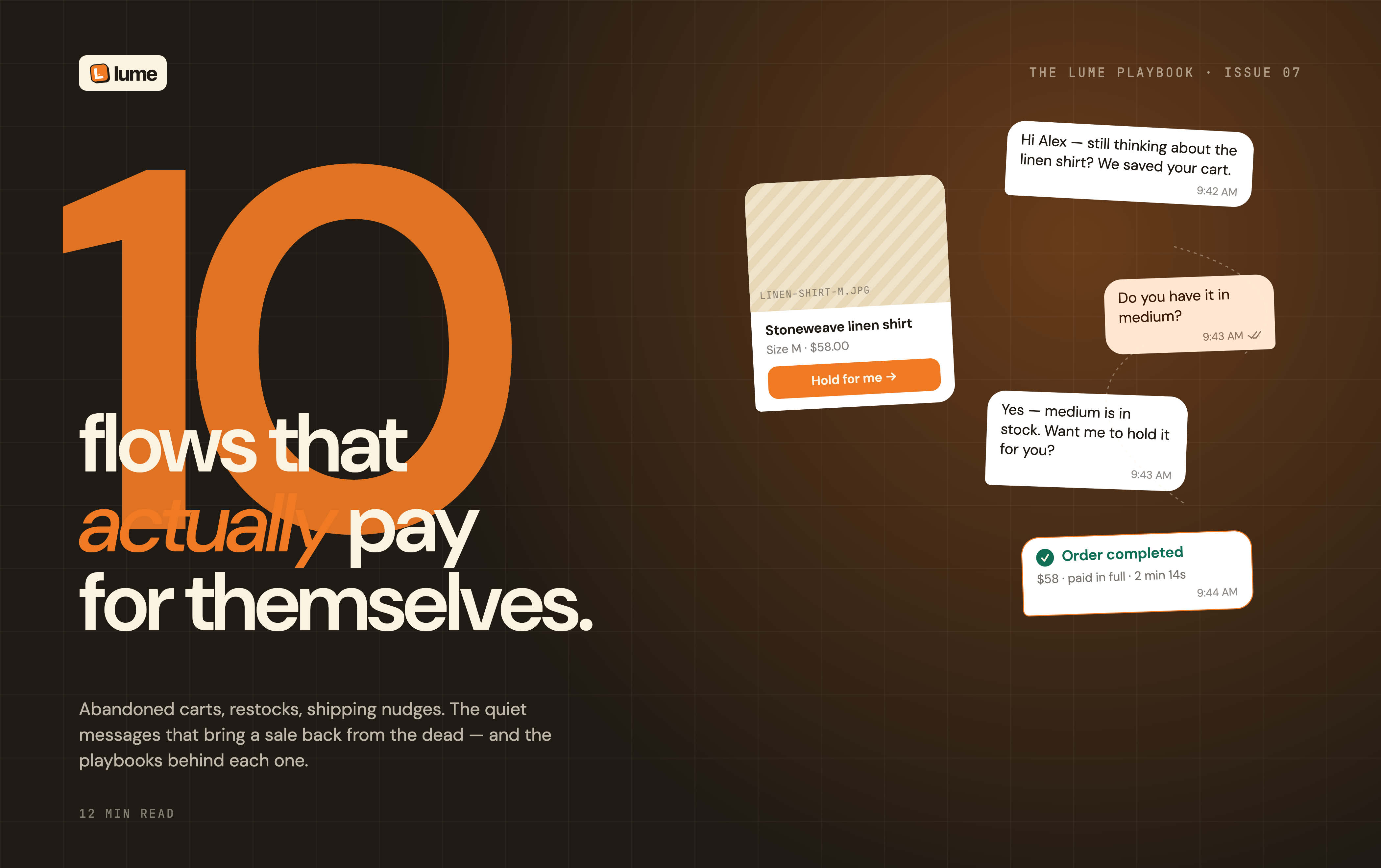
A shopper lands on your store. They click around, find something they like, add it to cart, start checkout — and then their kid screams, or a Slack notification pulls them away, or the shipping cost makes them pause. Whatever the reason, they leave. The cart sits there. The order never happens.
That's the moment most Shopify stores quietly lose money.
Not because the product is wrong. Not because the store looks bad. Because nobody followed up fast enough while the buying intent was still warm. An hour later that shopper is back on Instagram and the moment is gone.
This is the part of ecommerce that ad spend can't fix. You can pour more money into Meta or TikTok to get more carts started, but if the same percentage keeps dropping off at checkout, you're just paying more to leak more.
WhatsApp is one of the few channels that can actually catch these moments before they disappear. Not because it's trendy, but because it's where your customers already are. They're checking it for messages from their mum, their bank, and the courier dropping off their last Jumia order. Your "you forgot something" message sits in the same place — and gets opened in minutes instead of days.
The trick is using it well. WhatsApp is not another email list. If you blast promos every Tuesday, people will mute you and never come back. But if you use it for the moments where speed actually matters, it earns its place.
Here's how I'd think about it: email is for depth, WhatsApp is for urgency. Newsletters, product education, story-driven campaigns — keep those in email. The "your payment failed, here's a working link" message? That belongs on WhatsApp.
Let's get into the flows that actually move the needle.
The 10 flows worth building (in rough order of impact)
You don't need all ten on day one. Start with whichever one is closest to revenue for your store, prove it works, then add the next.
1. Abandoned checkout recovery
This is almost always the highest-ROI flow for a Shopify store, and it's where I'd tell anyone to start.
An abandoned checkout customer isn't a cold lead — they picked a product, entered details, and got within a few clicks of paying. Something stopped them. Maybe shipping cost, maybe distraction, maybe they wanted to check the price somewhere else.
A simple two- or three-message sequence works:
- 30–60 minutes after: a friendly nudge. No discount yet.
- 12–24 hours later: a softer reminder, maybe ask if they need help.
- 24–48 hours later: if they still haven't come back, offer a small incentive.
Resist the urge to lead with a discount. A lot of people don't need money off — they need a quick answer about delivery, or sizing, or whether the thing is in stock. Discounting too early trains people to wait for the discount.
2. Payment failure recovery
This one is underrated. The customer literally tried to give you money and the payment processor said no. They're already past hesitation — they decided to buy.
A short message that says "your order is almost done, here's a working link to retry" recovers a meaningful chunk of these. The customer wasn't backing out; the card just didn't go through, or the network blipped, or their bank flagged it.
If your payment provider exposes failed payment events through Shopify, build this. If it doesn't, this one's a "later" flow.
3. Cart abandonment
Different from checkout abandonment — these shoppers added something to cart but never entered checkout. The intent is real but softer.
Go gentle here. A "still thinking about this?" message with a way to ask questions works better than a discount or urgency tactic. For higher-priced items or products where buyers usually research before buying, a soft check-in converts better than a hard sell.
4. Checkout assistance
Some people don't need a reminder — they need help. Sizing, shipping fees, return policy, whether the colour they want is actually in stock.
A short message that opens the door for questions ("hey, anything we can help clear up before you finish ordering?") converts a particular kind of customer who would otherwise just leave. Especially useful for fashion, beauty, electronics, and anything north of $100.
5. Cash-on-delivery confirmation
If your store does COD, this might be the single most valuable flow you can build — possibly more important than checkout recovery.
COD is great because it boosts conversion (people trust paying on arrival more than typing card details into a site they don't know). But it's also where stores bleed money: fake orders, customers who go quiet when the courier arrives, deliveries that come back undelivered. Every failed COD costs you the round-trip logistics.
A WhatsApp confirmation step before dispatch — "reply YES to confirm your order, NO to cancel" — filters out the noise. The customers who reply YES are real. The ones who go quiet, you can deprioritise or skip entirely.
For stores in Ghana, Nigeria, Kenya, Egypt, Pakistan, anywhere COD is the default, this flow alone can change your unit economics.
6. Order confirmation
After the customer pays, they want to be told it worked. "Did my order go through?" is one of the most common support messages, and it's entirely preventable.
A short confirmation with the order number, what was bought, and when to expect shipping does the job. It also trains customers that messages from your store are useful, not spam — which makes the later promotional messages land better.
7. Shipping and delivery updates
"Where is my order?" is the other most common support question. Automate it away.
Useful triggers:
- Order shipped (with tracking link)
- Out for delivery (with a heads-up to keep their phone nearby)
- Delivered
- Delivery failed (with next steps)
Boring messages. High value. They reduce support tickets and make customers feel taken care of without you doing anything.
8. Post-delivery support follow-up
Once the order arrives, send a quick "did everything come through okay?" message.
This is not a review request. It's a support net. The goal is to catch problems — wrong size, damaged item, missing piece — before they turn into a chargeback, an angry DM, or a one-star review. A customer who has a small issue and gets it handled quickly often becomes more loyal than one whose order arrives perfectly.
9. Back-in-stock alerts
When someone wanted a product or variant that wasn't available, capture their number, and ping them the moment it's back. Specifically — name the product and variant, not just "we restocked."
Works especially well for fashion sizes, limited drops, and anything seasonal. The customer already raised their hand. You're just closing the loop.
10. Reorder and win-back
Last bucket — bringing existing customers back.
Reorder reminders make sense for things people use up: skincare, supplements, coffee, pet food, baby products. Time them to roughly when the customer is about to run out, not a week after they ordered.
Win-back messages are for customers who haven't bought in a while. A "we've got some new stuff since you were last here" message works better than another discount.
Match the flows to your store
Different stores need different starting points. A quick guide:
| Store type | Where to start |
|---|---|
| Fashion/apparel | Checkout recovery, back-in-stock by size, COD confirmation |
| Beauty/skincare | Reorder reminders, delivery updates, win-back |
| Electronics | Checkout assistance, payment recovery, shipping updates |
| Food and beverage | Reorder reminders, local delivery updates |
| COD-heavy stores | COD confirmation first, then everything else |
| Drop brands | Back-in-stock alerts, low-stock urgency, VIP early access |
Templates you can actually use
These are starting points — rewrite them in your brand's voice. The worst thing you can do is paste them in word-for-word and sound like every other Shopify store.
Abandoned checkout, friendly:
Hi {{first_name}}, still thinking about {{product_name}}? We saved your cart — finish up here: {{checkout_link}}
Abandoned checkout, helpful:
Hi {{first_name}}, anything we can help with before you finish ordering? Just reply here, or pick up where you left off: {{checkout_link}}
Payment failure:
Hey {{first_name}}, your order's almost done but the payment didn't go through. Try again here: {{checkout_link}}
COD confirmation:
Hi {{first_name}}, please confirm your order {{order_number}} for {{order_total}}. Reply YES to confirm or NO to cancel.
Order confirmation:
Thanks {{first_name}} — your order {{order_number}} is in. We'll message you again when it ships.
Shipping update:
Good news — your order {{order_number}} has shipped. Track it here: {{tracking_link}}
Post-delivery:
Hi {{first_name}}, your order should have arrived. Did everything come through okay? Reply YES if all good, or HELP if anything's off.
Back-in-stock:
Your size is back — {{product_name}} in {{variant_name}} is available again: {{product_link}}
Reorder:
Hi {{first_name}}, running low on {{product_name}}? Reorder in a couple of taps: {{reorder_link}}
The things nobody tells you
A few practical things that catch most stores off guard:
WhatsApp charges per conversation, and rates vary wildly by country. A flow that's profitable in India can be a money-loser in the UAE. Before you turn on a flow, check the rate for your customers' region and rough out whether the recovered revenue covers the message cost. For checkout recovery on a $40+ AOV store, it almost always does. For a $5 AOV store sending marketing blasts, it might not.
Meta rates your number for quality. Send too many messages people don't want, get too many blocks or opt-outs, and your number gets throttled. The fastest way to wreck your WhatsApp channel is to import a list of customers who never opted in and start blasting promos. Don't do this. Ever.
Consent has to be real. Customers should know they're signing up for WhatsApp messages, what kind, and how to opt out. A hidden checkbox at checkout isn't consent — it's a complaint waiting to happen. The rule I use: if you'd feel awkward explaining to a customer why they got the message, don't send it.
Separate transactional from marketing intent. Someone who agreed to get order updates didn't agree to get a flash sale every Friday. Treating these as the same thing is how you burn the channel.
What to actually measure
Forget vanity metrics. The numbers that matter:
- Recovered checkout revenue — is the flow paying for itself
- Opt-out rate — are you sending too much
- Reply rate — are customers engaged or confused
- Support ticket volume — is automation reducing your inbox load
In month one, those four tell you almost everything. Everything else is a distraction.
If clicks are high but conversions are low, the problem usually isn't the message — it's something on the checkout page. Shipping cost, payment options, delivery time, trust. Read the replies. Customers will literally tell you what's wrong if you give them a way to say it.
A note on where Lume fits
I'm building Lume for Shopify merchants who want this stuff running without having to wire up five tools and a Zapier graveyard. Abandoned checkout, COD confirmation, order updates, restock alerts, post-delivery follow-up — connected to your Shopify store, with the conversations actually tied to customer context instead of floating in a generic inbox.
If any of the flows in this post look like something you've been meaning to set up but haven't, that's the gap Lume is trying to fill.
The takeaway
Most of the money you're "losing" isn't really lost. It's sitting in abandoned checkouts, failed payments, unconfirmed COD orders, and customers who would buy again if you just reminded them at the right moment.
WhatsApp is one of the few channels fast enough to catch those moments before they slip away. Used carelessly, it'll get you muted. Used well, it quietly becomes one of the most profitable channels in your stack.
Start with abandoned checkout recovery. Add COD confirmation if you do cash on delivery. Then layer in order updates and post-delivery support. By the time you've done that much, you'll have a much clearer sense of where the next flow should go.
The shop down the street from yours isn't going to do this. That's kind of the point.
If you're running a Shopify store and want to stop losing sales after the click, take a look at Lume. It's built for exactly this.
Send your next order on WhatsApp.
Install Lume on Shopify or Wix. Live in two minutes. 14-day free trial, no card needed.
Start free trial →